
If you’ve got a lease event coming up in the next eighteen months — a break clause, a renewal, an expiry, a rent review — the next quarter or two will shape your occupancy costs for the rest of the decade. And the London market right now is a strange one. The headline numbers look contradictory unless you know how to read them. So let me walk you through what’s actually going on.
Two markets, not one
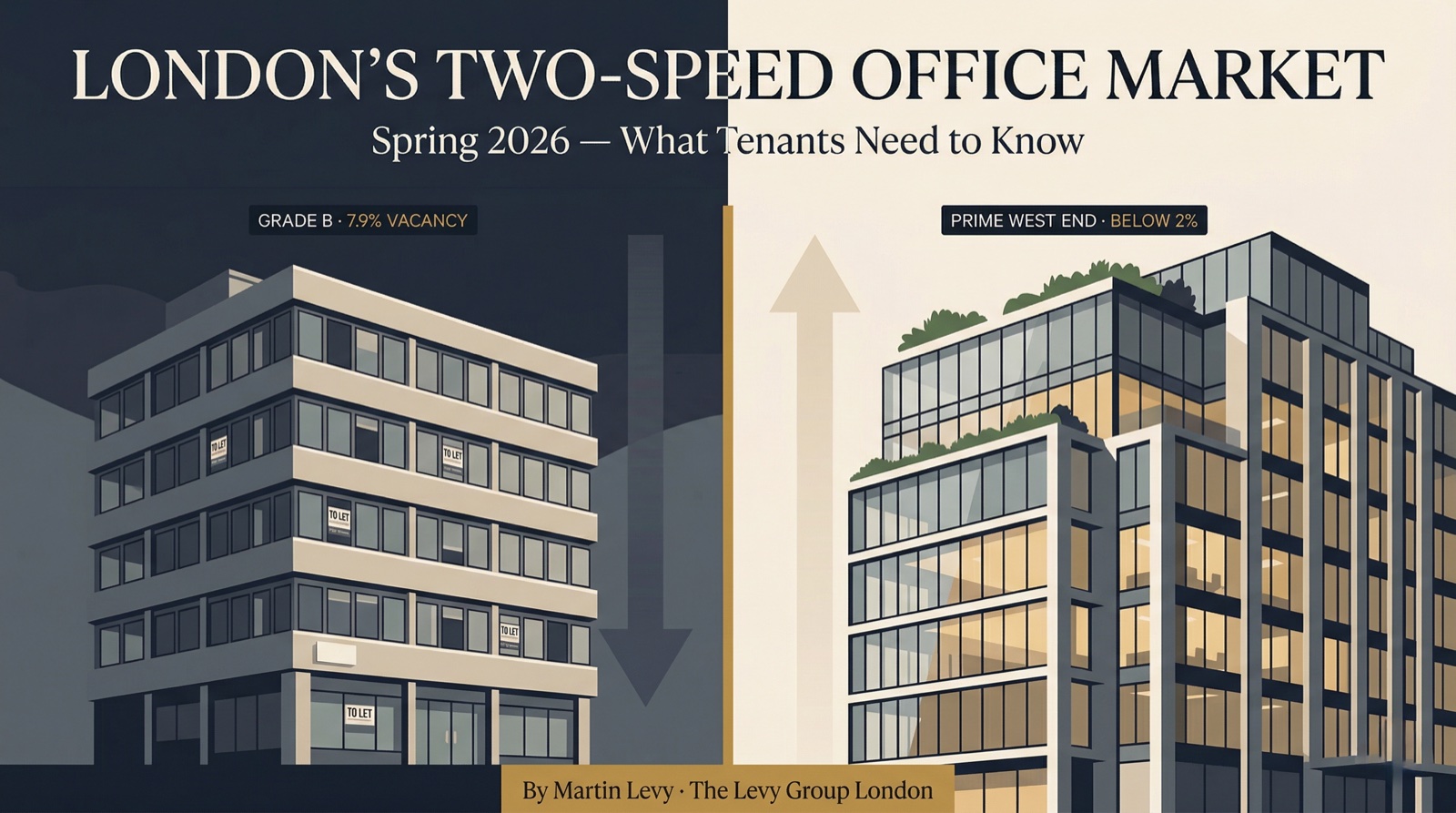
Here’s the puzzle. Central London office vacancy is sitting at 7.9 percent at the end of Q4 2025 — high by historical standards, though finally edging down from a peak of around 10.6 percent earlier in the year (Savills, Central London Office Market Watch — January 2026). And yet prime West End rents now average £166.61 per square foot, up 6.1 percent year-on-year. Mayfair and St James’s are routinely clearing £185 and above, and individual floors at 77 Grosvenor Street have gone for £217–£220 (Savills Q4 2025; Knight Frank, London Office Market Report 2025).
How can vacancy be high and rents be at record levels? Because there are two markets, not one.
The best buildings — modern, energy-efficient, hybrid-ready, the kind of thing your team will actually want to come into — are letting almost as fast as they can be delivered. Prime West End core vacancy is below 2 percent, and in genuinely new West End developments it’s just 0.8 percent (Langham Estate, 2025; London Property Alliance, Q1 2026). Knight Frank says prime West End rents grew 15.6 percent across 2025 — the fastest growth of any major global city it tracks (Property Week, 3 February 2026).
Meanwhile, older and less efficient stock — buildings that worked perfectly well five years ago — is sitting empty. That’s where the high headline vacancy figure is hiding. Savills is forecasting Grade B rents to fall by 1.5 percent in 2026 (Savills, Q4 2025). The two halves of the market are pulling apart in real time.
So when someone asks “how is the London office market right now?”, the honest answer is: which half are you in?
Three things you need to know
From the deals we’re working on right now, three patterns are clear.
Rent-frees are shrinking on the good stuff. Two years ago, you could comfortably negotiate twenty-two to twenty-four months rent-free on a ten-year lease in central London. Today, on prime Grade A space, those incentives have tightened toward eighteen to twenty-one months (CityHub Offices, 2025; Avison Young, Big Nine Report, 2025). Landlords of the best buildings know they hold the cards, and they’re using them. If your adviser is still benchmarking against last year’s packages, you’re leaving money on the table.
You need to start the conversation earlier than you used to. Large occupiers — anyone needing 100,000 square feet or more — are now routinely securing space up to four years ahead of their lease expiry. A record 2.7 million square feet of London leasing in 2025 took the form of pre-lets (K2 Space; Knight Frank, 2025). That’s not bullishness about expansion. That’s defensiveness — people have realised the best space is gone the moment it appears. Even at smaller sizes, lead times have stretched. If you wait until the last six months of your lease to pick up the phone, your best options will already have quietly disappeared.
There’s real value in the second-tier market — for the right occupier. While prime is tight, the older stock is a genuine opportunity if you don’t need the trophy address. Landlords are willing to talk, willing to discount, willing to contribute generously to your fit-out. The trick is knowing which of these buildings have a credible plan behind them and which are quietly being left behind. That’s not a judgement you can make from a brochure. It takes someone who’s been in the room with these landlords for years.
The question worth asking yourself
Here’s the question I’d put to you this quarter: if your lease event arrived tomorrow, would you be making decisions from a position of choice, or a position of pressure?
In a market this divided, the difference between those two positions is measured in pounds per square foot, in months of rent-free, in capital contributions, in flexibility on break clauses — and ultimately in whether the building you end up in is one that helps your business grow or one that holds it back for the next decade.
The most expensive mistake we see London tenants make right now is leaving the conversation too late. It doesn’t need to happen.
Got a lease event on the horizon? Let’s have a coffee. Call me on +44 7968 191 233, email martinl@thelevygroup.london, or come and see us at 34 South Molton Street, Mayfair. No gatekeepers, no junior staff — just straight, tenant-only advice on where you actually stand.
Sources
- Savills, Central London Office Market Watch — January 2026 (Q4 2025 data)
- Savills, Central London Office Market Watch Q4 2025
- Knight Frank, London Office Market Report 2025, as reported in Property Week, 3 February 2026
- London Property Alliance, Global Cities Barometer, Q1 2026
- Langham Estate, London Office Market Report 2025
- K2 Space, Office Rent London 2026
- CityHub Offices, London Office Space Market Update, 2025
- Avison Young, Big Nine Report, 2025